The Ultimate Buyer's Guide to Strapping Machines (2026)
Buying the wrong strapping machine costs more than the machine itself. It costs you line speed, rework, and a second procurement cycle six months later. This guide breaks down the specs, materials, and industry fit that actually determine whether a strapping machine earns its place on your line, so you can walk into a quote conversation already knowing what you need.

What Is a Strapping Machine and How Does It Work?
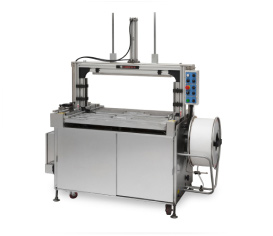
A strapping machine secures a package, case, or pallet by feeding a plastic strap around it, pulling it to a set tension, sealing the overlapping ends, and cutting the strap free of the coil. Every model on the market runs some version of that four-step cycle: feed, tension, seal, cut.
Where machines differ is how much of that cycle requires a person. A semi-automatic strapping machine still needs an operator to position the package and feed the strap into the sealing slot. A fully automatic strapping machine detects the package on a conveyor and runs the entire cycle without hands-on involvement. That distinction, more than any single spec, is where most buyers should start.
The sealing step is worth understanding on its own, because it determines which strap material a machine can run. Heat sealing uses a heated blade to fuse the overlapping ends of PP strap and is the standard method on most general-purpose machines. Friction welding uses high-frequency vibration to generate heat at the seal point instead of a heating element, which is what allows a machine to fuse the denser PET strap used on heavier, palletized loads. A machine built for one sealing method generally cannot be retrofitted to the other, so this decision has to happen before you order rather than after.
|
Evaluation Factor |
Why It Matters |
|
Throughput Capacity |
Sets whether the machine can match your conveyor's indexing rate without creating a bottleneck or sitting idle. |
|
Sealing Method |
Heat seal and friction weld are not interchangeable after purchase. This decision locks in which strap material the machine can run. |
|
Tension Control |
Determines whether the machine can protect fragile cartons while still holding heavy pallet loads securely. |
|
Arch and Frame Sizing |
An arch sized for your largest package without being oversized keeps cycle speed and tension accuracy from dropping. |
|
Environmental Rating |
Wash-down, high-humidity, or dusty environments require sealed cabinets and corrosion-resistant construction to avoid premature failure. |
|
Line Integration |
Confirms the machine's sensors and controls are rated to run at your actual line speed, not just its isolated top speed. |
Automatic vs. Semi-Automatic: Which Type Fits Your Line?
This decision deserves its own comparison, and we've written one: Automatic vs. Semi-Automatic Strapping Machines: A Side-by-Side Comparison. The short version below covers what to weigh before you spec either type.
- A fully automatic strapping machine fits high-volume lines with consistent package sizes moving on a conveyor, where labor reduction and cycle speed matter most.
- A semi-automatic strapping machine fits lower to mid-volume operations, variable package sizes, or standalone stations where a lower upfront cost matters more than top-end speed.
Key Specs to Compare Before You Buy
Manufacturer spec sheets lead with peak cycle speed, but a handful of other specs determine whether that speed is actually usable on your line.
- Throughput. Landen's single-head strapping machines run 55 or more straps per minute, and dual-head configurations exceed 110 straps per minute. Match this figure to your conveyor's indexing rate, not just your target output. A machine rated faster than the line feeding it is capital you paid for and can't use.
- Tension control. Servo-driven tensioning and PLC-controlled strap feed keep tension consistent cycle after cycle. Mechanical, non-adjustable tensioning is fine for uniform rigid loads but risks crushing lighter cartons.
- Frame and environment. Standard carbon steel frames cover most dry manufacturing floors. Facilities running wash-down protocols need stainless steel, NEMA 4X-rated construction to hold up against daily cleaning and moisture.
- Integration. Confirm the arch or track dimensions accommodate your largest package and that the machine's automatic loop ejection and product-detection sensors are rated for your line speed, not just the machine's isolated cycle speed.
Strapping Machine Standards and Safety
Two standards come up repeatedly in strapping machine procurement, and it's worth knowing what each one actually covers. ASTM D3950 sets the specification for nonmetallic strapping itself, covering break strength, elongation, and joining methods for PP and PET strap. It's a standard for the consumable, not the machine, but a machine's tensioning range has to be able to work within the break strength the strap is rated for. ISO 12100 is the general machinery safety standard covering risk assessment and risk reduction, which is the basis for guarding, emergency stop placement, and interlocked access panels on the machine itself.
You don't need to become an expert in either standard to buy well. You do need a supplier who can speak to both when asked, since a machine that can't be tied back to a recognized safety framework is a liability on the floor, not just a paperwork gap.
Strapping Material: PP vs. PET
The machine and the strap have to be specified together. Landen supplies both polypropylene (PP) strapping and polyester (PET) strapping matched to each machine we build. PP is the standard choice for light and medium loads and is more forgiving on tension settings. PET holds tension longer on heavier, denser loads and is the better fit for palletized freight and lumber bundles that sit in storage before shipping.
|
|
Heat Seal (PP) |
Friction Weld (PET) |
|
Strap Compatibility |
Polypropylene strapping |
Polyester strapping |
|
Best For |
Light to medium loads, general packaging |
Heavy, dense, or palletized loads |
|
Maintenance Note |
Lower mechanical complexity |
Sealing head needs regular cleaning to clear friction debris |
Matching a Strapping Machine to Your Industry
The right configuration depends heavily on what you're packaging and under what conditions:
- Food Processing: Wash-down, stainless steel strapping machines built to handle daily high-pressure cleaning for beef, pork, poultry, and seafood packaging.
- Lumber and PVC Pipe: Pallet strapping machines built for oversized, uneven loads that standard box strapping equipment can't bundle securely.
- Corrugated and Carton Packaging: Inline strapping machines that integrate directly into conveyor-fed box lines running continuous cycles.
- Tobacco: Side-seal strapping machines delivering precise, consistent tension across extended production runs.
Common Buying Mistakes to Avoid
- Sizing the machine to its own top speed instead of your line's real throughput. A machine rated for 60 straps per minute sitting behind a conveyor that indexes 20 packages per minute is wasted capital.
- Pairing a precision machine with mismatched strap. Strap that doesn't match the machine's tolerances causes feed jams and weak seals regardless of how well-built the machine is.
- Skipping the on-site evaluation. Arch size, conveyor height, and floor space constraints are easy to miss on paper and expensive to fix after installation.
- Overlooking future line integration. If there's any chance your facility will need the machine to report cycle data or tie into a broader automation system down the line, raise it during procurement. Retrofitting controls after installation costs more than specifying them up front.
Questions to Ask Your Strapping Machine Supplier
A supplier's answers to a few direct questions will tell you more than a spec sheet ever will:
- What strap camber can the feed rollers tolerate? Curved or inconsistent strap is a leading cause of feed jams, and the answer tells you how forgiving the machine is of real-world strap quality.
- Are the wear parts proprietary? Sealing blades, feed rollers, and tensioning grippers wear out on a schedule. Know whether replacements come from one source or can be sourced locally.
- How does the machine hold tension over time? Closed-loop systems that verify tension every cycle with load-cell feedback hold up better long-term than open-loop timer-based tensioning, which can drift as components wear.
- What's the service history on the sealing head? The sealing head is the most mechanically complex part of the machine. A supplier who can speak to its real-world reliability at your expected cycle speed is one worth buying from.
Get a Custom Recommendation from Landen
Landen has engineered and manufactured strapping machines for decades, and every custom machine we build starts with an on-site evaluation of your actual line, not a spec sheet. If you already know which type fits your operation, our team can help you land on the exact configuration.
Contact our team today to request a quote or schedule an on-site evaluation.
Frequently Asked Questions About Strapping Machines
What is the difference between an automatic and a semi-automatic strapping machine?
A semi-automatic strapping machine requires an operator to position the package and feed the strap into the sealing slot for each cycle. A fully automatic strapping machine detects the package on a conveyor and runs the entire feed, tension, seal, and cut cycle without operator involvement.
How do I know what strapping machine speed I need?
Base the decision on your conveyor's indexing rate rather than the machine's peak rated speed. A machine capable of more straps per minute than your line can feed it does not add throughput, it adds unused capacity.
Should I use polypropylene or polyester strapping?
Polypropylene (PP) strapping suits light to medium loads and is more forgiving on tension settings. Polyester (PET) strapping holds tension longer under heavier, denser loads, making it the better fit for palletized freight and lumber bundles.
Can a strapping machine integrate with my existing conveyor system?
Yes. Landen's strapping machines connect into existing conveyor layouts with custom arch sizing matched to your line, and our team handles the on-site evaluation and installation.
Does Landen build custom strapping machine configurations?
Yes. Landen offers custom design configurations instead of a one-size-fits-all approach, engineered around your product dimensions, throughput targets, and facility conditions.
Related Blog Articles
Explore more insights on packaging equipment, materials, and industry solutions from the Landen Strapping team.