How Much Does a Strapping Machine Cost? (2026 Pricing & ROI Breakdown)
Investing in a strapping machine can improve packaging efficiency, reduce labor costs, and streamline production. But before purchasing equipment, most businesses have one important question: How much does a strapping machine cost?
Strapping machine prices vary by equipment type, automation level, production capacity, and specific application. A basic manual strapping tool may cost a few hundred dollars, while a fully automatic industrial strapping system can represent a much larger investment.
However, the initial purchase price doesn't tell the whole story. The right equipment can reduce packaging time, improve consistency, and generate long-term savings.
In this guide, we'll break down typical strapping machine prices, explain what influences equipment costs, and show you how to calculate the potential return on investment (ROI).

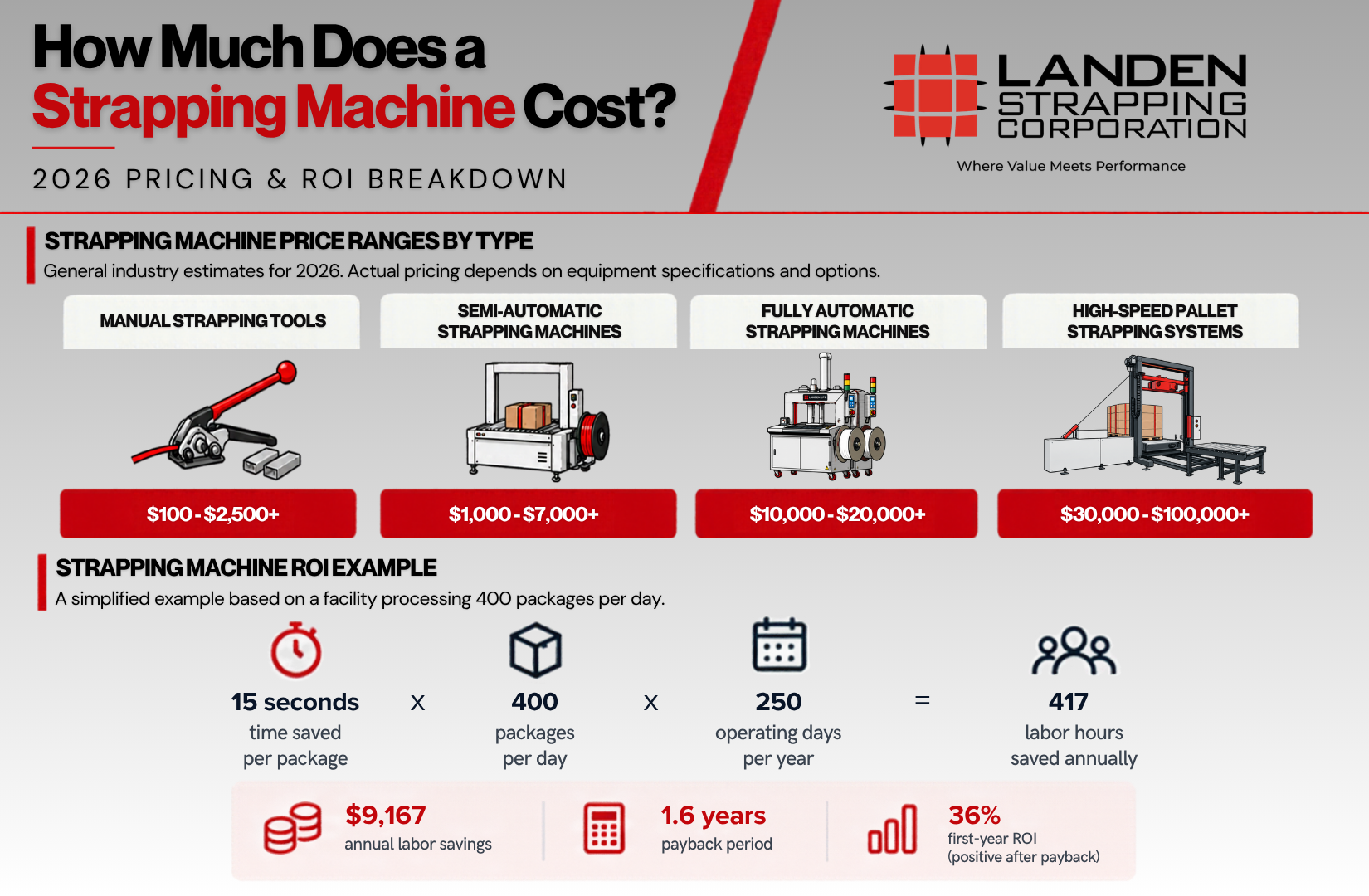
Strapping Machine Price Ranges by Type
Strapping machines come in different price ranges depending on their capabilities and intended applications.
The following ranges are general industry budgeting estimates for 2026, not official Landen Strapping Corporation prices.
|
Strapping Equipment Type |
Estimated Price Range |
|
Manual Strapping Tools |
100–2,500+ |
|
Semi-Automatic Strapping Machines |
1,000–7,000+ |
|
Fully Automatic Strapping Machines |
$15,000–$20,000+ |
|
High-Speed Pallet Strapping Systems |
$30,000–$100,000+ |
Actual pricing depends on equipment specifications, optional features, and installation requirements.
Manual Strapping Tools
Manual strapping tools are generally the most affordable option for businesses with occasional or low-volume packaging requirements.
These tools allow operators to tension and secure strapping around packages, bundles, or pallets. Common options include handheld tensioners, sealers, and battery-powered strapping tools.
Manual tools are often used in small warehouses, shipping departments, and operations handling irregularly shaped products.
While they require a lower initial investment, manual strapping can become labor-intensive as packaging volume increases. Operators must spend time positioning, tensioning, and sealing each strap.
For businesses experiencing growth, transitioning to a semi-automatic or automatic strapping machine may provide better long-term efficiency.
Semi-Automatic Strapping Machines
A semi-automatic strapping machine offers an affordable introduction to packaging automation. These machines typically automate strap tensioning, sealing, and cutting while requiring an operator to position the package and guide the strap.
Semi-automatic machines are commonly used in distribution centers, manufacturing facilities, and general packaging operations.
They provide several advantages over manual tools, including:
- Reduced manual effort
- More consistent strap tension
- Faster packaging cycles
- Improved packaging efficiency
For businesses with moderate packaging volumes, semi-automatic machines often provide an effective balance between equipment cost and productivity.
Fully Automatic Strapping Machines
A fully automatic strapping machine is designed for operations requiring greater speed, consistency, and minimal operator involvement. Unlike semi-automatic machines, fully automatic systems can integrate directly into production lines, allowing packages to move through the strapping process without manual positioning or strap application.
These machines automatically detect incoming packages and perform the strapping cycle, including strap feeding, tensioning, sealing, and cutting.
Fully automatic strapping machines are particularly beneficial for businesses with high production volumes, repetitive packaging requirements, and continuous manufacturing operations.
Key advantages include:
- Reduced manual labor and operator involvement
- Faster and more consistent packaging cycles
- Improved production-line efficiency
- Integration with conveyor systems
- Reliable strapping performance for high-volume applications
Although fully automatic strapping machines require a higher initial investment, the potential improvements in throughput, labor efficiency, and packaging consistency can help justify the cost over time.
High-Speed Pallet Strapping Systems
High-speed industrial strapping systems are designed for demanding production environments where packaging equipment must keep pace with continuous operations. These systems may include conveyor integration, automated product detection, specialized controls, and customized machine configurations.
They are commonly used in industries such as lumber, building materials, manufacturing, and high-volume distribution.
Because industrial applications vary considerably, pricing is typically determined through a customized quotation. The investment depends on factors such as production speed, package dimensions, strapping requirements, and integration with existing equipment.
What Factors Affect Strapping Machine Cost?
Two strapping machines may appear similar but have very different prices. Understanding the factors that influence equipment cost can help businesses choose the right solution without paying for unnecessary capabilities.
Automation Level and Throughput Speed
Automation is a major factor affecting strapping machine prices. Manual tools require significant operator involvement, while semi-automatic and fully automatic machines handle more of the packaging process. Higher-speed equipment may also require more advanced mechanical components and controls.
However, purchasing the fastest available machine isn't always necessary. The goal should be to select equipment that meets current production requirements while allowing room for future growth.
Strap Material Compatibility
The type of strapping material used can influence machine selection and pricing.
Polypropylene (PP) strapping is commonly used for cartons, lightweight bundles, and general packaging applications.
Polyester (PET) strapping is often used for heavier loads requiring greater tension and load stability.
Different strapping materials require compatible feeding, tensioning, and sealing systems. Not every machine supports both materials, so confirming compatibility before purchasing is essential.
Choosing the correct equipment and strapping material combination helps maintain packaging performance while avoiding unnecessary expenses.
Brand Quality and Warranty Terms
When comparing strapping machine prices, it's important to look beyond the initial purchase cost and consider the long-term value offered by the manufacturer.
A reputable brand should be evaluated on machine construction, component quality, reliability, and the availability of technical support and replacement parts. These factors can directly affect performance, maintenance costs, and potential downtime.
Warranty length and coverage are also important considerations. A longer warranty may add value, but buyers should understand exactly what it covers, including parts, labor, exclusions, and service requirements.
For example, a lower-priced machine with limited warranty coverage and difficult-to-source replacement parts could become more expensive to maintain over time. Before purchasing, businesses should compare not only the equipment price but also the manufacturer's reputation, warranty terms, service capabilities, and expected equipment lifespan.
At Landen Strapping Corporation, our philosophy is Reliability Through Simplicity. We believe packaging equipment should deliver dependable performance, straightforward operation, and practical maintenance without unnecessary complexity.
Optional Features and Add-Ons
Additional features can also influence the final equipment price.
Depending on the application, these may include:
- Conveyor integration
- Specialized arch dimensions
- Stainless-steel construction
- Automatic package detection
- Custom controls and production-line integration
While these features can improve efficiency, not every operation requires them.
An experienced equipment supplier can help you identify which features add meaningful value for your application.
Total Cost of Ownership: Beyond the Purchase Price
When evaluating strapping equipment, businesses should consider the total cost of ownership (TCO) rather than focusing only on the initial investment.
Total cost of ownership includes the expenses associated with purchasing, operating, and maintaining equipment throughout its service life.
These costs typically include:
- Equipment purchase: The initial machine investment and installation expenses.
- Strapping materials: Ongoing polypropylene or polyester strapping consumption.
- Maintenance and replacement parts: Routine servicing and repairs.
- Energy consumption: Electricity required to operate the equipment.
- Labor costs: Operator time needed to complete the packaging process.
- Downtime: Potential production interruptions caused by equipment issues.
For example, a lower-priced machine may require more operator involvement than a higher-priced fully automatic system.
If the fully automatic machine significantly reduces packaging time, the labor savings may offset the additional purchase cost. This is why comparing equipment based solely on its selling price can be misleading.
Businesses should evaluate how each machine will perform over several years, particularly in operations where packaging equipment is used daily.
Proper maintenance and reliable technical support can also help reduce unexpected operating expenses and extend equipment life.
How to Calculate Your Strapping Machine ROI
Return on investment (ROI) helps determine whether purchasing a strapping machine makes financial sense.
For most packaging operations, the primary financial benefits come from reduced labor requirements, improved throughput, and more consistent packaging performance.
A simplified first-year ROI calculation is:
ROI (%) = [(Annual Net Savings − Initial Investment) ÷ Initial Investment] × 100
Annual net savings represent measurable operating savings after subtracting any additional annual expenses associated with the new equipment.
Example: Calculating Strapping Machine ROI
Consider a distribution facility that processes 400 packages per day.
The company currently relies on a manual strapping process and is considering a fully automatic strapping machine.
Assume the following:
|
Factor |
Example |
|
Packages processed daily |
400 |
|
Operating days annually |
250 |
|
Time saved per package |
15 seconds |
|
Labor cost per hour |
$22 |
|
Machine investment |
$12,000 |
|
Additional annual operating costs |
$1,500 |
Step 1: Calculate annual labor hours saved
400 packages × 15 seconds × 250 days ÷ 3,600 = approximately 417 hours saved annually.
Step 2: Calculate annual labor savings
417 hours × $22 = approximately $9,167 in annual labor savings.
Step 3: Calculate annual net savings
$9,167 − $1,500 = approximately $7,667.
Step 4: Calculate the payback period
$12,000 ÷ $7,667 = approximately 1.6 years.
In this example, the fully automatic strapping machine could recover its initial investment in approximately 19 months, assuming the labor savings are fully realized, and operating conditions remain consistent.
The first-year ROI would be approximately -36%, since the machine has not yet recovered its purchase cost during the first 12 months.
Over a longer period, however, the accumulated savings can make the investment financially attractive.
Additional Benefits Beyond Labor Savings
Not every benefit of automation can be measured through labor costs alone.
Consistent strapping tension and sealing can help reduce packaging errors and improve product security during handling and transportation.
Faster packaging cycles may also reduce production bottlenecks, particularly during periods of increased demand.
Automation can reduce repetitive manual tasks and allow employees to focus on other production activities.
While these benefits may be harder to quantify, they can contribute to the overall value of a strapping machine investment.
Get the Right Strapping Machine at the Right Price
Choosing the right strapping machine involves more than comparing purchase prices.
Manual tools may be suitable for occasional packaging, while semi-automatic machines provide an affordable step toward automation. For higher-volume operations, fully automatic and industrial strapping systems can offer greater efficiency and long-term savings.
The best solution is equipment that matches your production requirements, delivers dependable performance, and provides measurable value over time.
At Landen Strapping Corporation, we help businesses identify reliable strapping solutions designed for their specific packaging applications.
Whether you're replacing existing equipment, upgrading from manual strapping, or exploring automation, our team can help you evaluate your options.
Ready to find the right solution for your operation?
Contact Landen Strapping Corporation today to request a custom quote and discuss your packaging equipment needs.
Frequently Asked Questions About Strapping Machine Pricing
How Can I Get an Accurate Strapping Machine Price?
The most accurate way to determine strapping machine pricing is to request a quote based on your specific packaging requirements.
Factors such as package dimensions, daily production volume, strapping material, and desired automation level help determine the appropriate equipment.
These details allow Landen Strapping Corporation to recommend a suitable machine and prepare a customized quotation.
How Long Does a Strapping Machine Take to Pay for Itself?
The payback period depends on the initial equipment cost, production volume, labor savings, and ongoing operating expenses.
Operations with higher packaging volumes may pay back faster because automation can eliminate more repetitive manual work.
A simple estimate is to divide the initial equipment investment by annual net savings.
Is a More Expensive Strapping Machine Worth It?
A higher-priced machine may offer better value if it improves production efficiency, reduces labor requirements, or provides greater reliability.
However, the most expensive machine isn't necessarily the best choice.
The right investment depends on your production requirements, packaging applications, and expected long-term operating costs.
Related Blog Articles
Explore more insights on packaging equipment, materials, and industry solutions from the Landen Strapping team.