Automatic vs. Semi-Automatic Strapping Machines: A Side-by-Side Comparison
The choice between an automatic and a semi-automatic strapping machine comes down to how much operator involvement your line can afford and how consistent your package sizes are. This comparison breaks down the real operational differences, including cycle time, floor space, and total cost of ownership, so you can match the equipment to your throughput instead of your budget alone.

What Is a Semi-Automatic Strapping Machine?
A semi-automatic strapping machine automates tension, sealing, and cutting, but an operator still positions the package and triggers each cycle, typically with a foot pedal or push button. That manual step makes semi-automatic machines well suited to operations where package sizes shift frequently or where line volume doesn't justify a conveyor-integrated system.
Landen's semi-automatic lineup includes standard, stainless steel, side-seal, and low-table configurations, so the manual step doesn't mean giving up durability or tension consistency.
What Is an Automatic Strapping Machine?
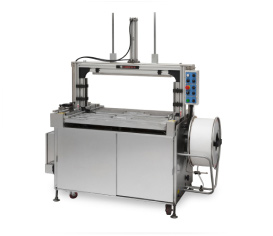
A fully automatic strapping machine removes the operator from the cycle entirely. Packages move through on a conveyor, sensors detect each one, and the machine feeds, tensions, seals, and cuts the strap without manual input. Landen's automatic strapping machines run at 55 or more straps per minute on single-head models and exceed 110 straps per minute on dual-head configurations, with servo-driven tensioning and PLC-controlled feed keeping every cycle consistent.
Automatic vs. Semi-Automatic: Side-by-Side Comparison
A machine's rated cycle speed and its real-world throughput are not the same number. On a semi-automatic machine, the operator sets the pace: positioning the package, feeding the strap, and triggering the cycle all take time the mechanical cycle rate doesn't count. On a fully automatic machine, the sensor-triggered cycle runs at the machine's actual rated speed shift after shift, which is why the gap between the two types widens as volume climbs.
|
Factor |
Semi-Automatic |
Fully Automatic |
|
Operator Involvement |
Positions package and triggers each cycle |
None once running; sensors trigger the full cycle |
|
Typical Throughput |
Lower, limited by operator pace |
55+ straps per minute single-head, 110+ dual-head |
|
Upfront Investment |
Lower |
Higher, includes conveyor and sensor integration |
|
Best Fit |
Variable package sizes, lower to mid volume |
Consistent package sizes, high-volume conveyor lines |
|
Maintenance |
Simpler mechanical upkeep |
Requires PLC, sensor, and arch maintenance |
|
Floor Space |
Standalone station, compact footprint |
Integrated into conveyor line layout |
Floor Space and Line Layout
Floor space is often the deciding factor once throughput and budget both check out. A semi-automatic strapping machine works as a standalone station: set it on a bench or floor stand, give the operator room to move packages in and out, and it's ready to run. A fully automatic strapping machine needs to sit inline with a conveyor, which adds in-feed and out-feed length to your layout, and pallet-strapping arches need overhead clearance for the strap to travel through the frame.
|
Layout Factor |
Semi-Automatic |
Fully Automatic |
|
Footprint |
Compact, standalone station |
Requires conveyor in-feed and out-feed length |
|
Ceiling Clearance |
Minimal |
Arch height needed for pallet strapping configurations |
|
Mobility |
Portable options available |
Fixed once integrated into the line |
|
Utility Requirements |
Standard power in most cases |
May need compressed air or additional controls wiring |
Which Strapping Machine Is Right for Your Operation?
If you're still weighing broader buying criteria beyond automation level, our companion piece, The Ultimate Buyer's Guide to Strapping Machines (2026), covers specs, materials, and industry fit in more depth. For the automation decision specifically, weigh these factors:
- Package consistency: variable sizes favor semi-automatic; uniform sizes favor fully automatic.
- Line volume: low to mid volume rarely justifies conveyor integration and sensor maintenance.
- Labor availability: fully automatic machines reduce dependence on a dedicated operator per shift.
- Floor plan: semi-automatic stations work as standalone islands; automatic systems need conveyor space.
As a general rule of thumb, operations running under roughly 100 packages per hour with mixed sizes tend to get more value from a semi-automatic machine, while sustained volume well above that starts to justify the higher upfront cost of a fully automatic system. Your actual threshold depends on labor cost, shift structure, and how much variation your packages really have, which is exactly what an on-site evaluation is for.
Key Features to Compare Beyond Automation Level
Automation level is the headline decision, but a few features determine how well either machine actually performs day to day:
- Tension control. Servo-driven, electronically adjustable tension protects fragile cartons while still holding heavy loads securely. Purely mechanical tensioning is less forgiving on mixed product.
- Anti-jam and loop ejection. Automatic loop ejection clears a failed strap and re-feeds without operator intervention, which matters more as cycle count climbs.
- Environmental rating. Wash-down or high-moisture environments need stainless steel, NEMA 4X-rated construction regardless of automation level.
- Mobility. Some semi-automatic machines mount on casters for use across multiple stations. Fully automatic machines are fixed once integrated into a line.
Signs It's Time to Upgrade to Fully Automatic
Many operations start with a semi-automatic machine and upgrade once volume justifies it. Watch for these signals:
- Your operator can't keep pace. If strapping is the reason packages back up before shipping, the bottleneck has moved to the strapping station.
- You're adding a second or third shift. Each additional shift on a semi-automatic machine means another dedicated operator; a fully automatic machine adds capacity without adding headcount.
- Package sizes have standardized. If your product mix has consolidated around a few consistent dimensions, the flexibility advantage of semi-automatic matters less.
- Volume has grown steadily. A machine sized for last year's throughput is often the first constraint on this year's growth.
Industries That Rely on Each Type
Most facilities end up running both types for different parts of the operation:
- Food Processing: High-volume beef, pork, and poultry lines typically run wash-down, fully automatic stainless steel machines, while smaller batch or specialty lines use semi-automatic stainless models.
- Lumber and PVC Pipe: Bulky, uneven loads on lumber packaging lines often need the sustained cycle speed of a fully automatic pallet strapping machine.
- Corrugated and Carton Packaging: Conveyor-fed corrugated box lines lean fully automatic; lower-volume finishing stations often keep a semi-automatic machine on hand.
- Tobacco: Precise, consistent tension on tobacco case packaging runs well on either type, with the choice driven mainly by case volume per shift.
Total Cost of Ownership: What to Weigh Beyond the Price Tag
The purchase price is where most comparisons start and where they shouldn't end. A full cost picture includes what happens after the machine is running.
|
Cost Factor |
Semi-Automatic |
Fully Automatic |
|
Purchase Price |
Lower |
Higher, includes integration |
|
Ongoing Labor |
Requires a dedicated operator per shift |
Minimal, line-level supervision only |
|
Maintenance Complexity |
Basic mechanical upkeep |
PLC, sensor, and arch maintenance |
|
Consumables |
Same PP or PET strap cost either way |
Same PP or PET strap cost either way |
|
Cost Pattern Over Time |
Lower fixed cost, ongoing labor cost |
Higher fixed cost, labor cost drops after install |
Which pattern wins depends on your labor cost, shift count, and how long you plan to run the equipment. That's a conversation worth having with your supplier before you buy, not after.
Talk to Landen About the Right Strapping Machine for Your Line
Landen builds both automatic and semi-automatic strapping machines, and every custom machine we configure starts with an on-site evaluation of your actual packaging line, not a generic spec sheet.
Get in touch with our team today to request a quote or schedule an on-site evaluation.
Frequently Asked Questions About Automatic and Semi-Automatic Strapping Machines
What is the main difference between automatic and semi-automatic strapping machines?
A semi-automatic strapping machine requires an operator to position the package and trigger each cycle. A fully automatic strapping machine detects the package on a conveyor and completes the entire feed, tension, seal, and cut cycle without operator input.
Which type of strapping machine is faster?
Fully automatic strapping machines are faster. Landen's automatic single-head models run 55 or more straps per minute, and dual-head configurations exceed 110 straps per minute, well beyond what an operator-paced semi-automatic cycle can sustain.
Is a semi-automatic strapping machine cheaper than an automatic one?
Yes, semi-automatic strapping machines typically carry a lower upfront cost since they don't require conveyor integration, sensors, or PLC controls. The trade-off is lower throughput and continued reliance on an operator.
Can a fully automatic strapping machine handle varied package sizes?
Fully automatic machines are optimized for consistent package dimensions, since the arch and sensors are set to a defined size range. Facilities with highly variable package sizes typically get more practical flexibility from a semi-automatic machine, where an operator can adjust placement for each unique package.
Is there a volume threshold where fully automatic starts to make more sense?
As a general guideline, operations running under roughly 100 packages per hour with mixed sizes tend to get more value from semi-automatic equipment, while sustained volume well above that starts to justify the higher upfront cost of fully automatic. The right threshold for your facility depends on labor cost and shift structure, which an on-site evaluation can confirm.
Can I run automatic and semi-automatic strapping machines in the same facility?
Yes. Many facilities run fully automatic machines on high-volume conveyor lines and keep semi-automatic machines on hand for variable package sizes, overflow capacity, or standalone packing stations.
How do I decide which strapping machine type fits my operation?
Start with your line volume and package consistency. Consistent packages on a conveyor at high volume point toward fully automatic. Variable package sizes or lower volume point toward semi-automatic. Landen's team can confirm the right fit with an on-site evaluation.
Related Blog Articles
Explore more insights on packaging equipment, materials, and industry solutions from the Landen Strapping team.